Context
Since 2023 I have led Product at Simple, a consumer health app with over 20 million downloads and over 100,000 daily active users. This role involved working alongside medical and nutrition experts and managing the Science team.
What the real problem was
Retention in consumer health is usually pursued through mechanics such as streaks, reminders, prompts. Those help, but they only hold if the user is getting somewhere. The work I have led treats the user’s own outcome as the retention strategy: making progress visible, feedback relevant and contextual, the next action small enough to take daily and ensuring it is all guided by accurate AI coaching - so that experts will stand behind it.
What I built
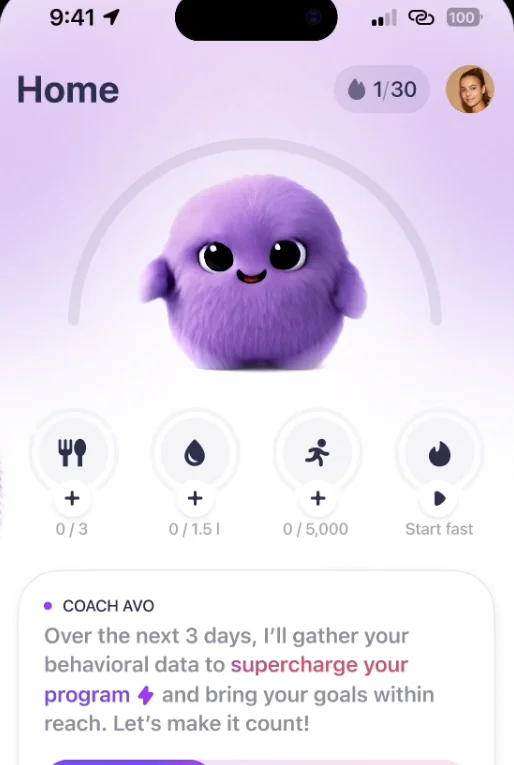
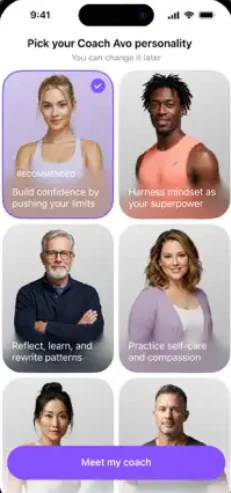
Avo is the AI coach at the centre of Simple: a science-led coaching layer built into the app rather than added alongside it and grounded in the evidence the medical, nutrition and behaviour change teams stand behind. Here are some of the key initiatives I led.
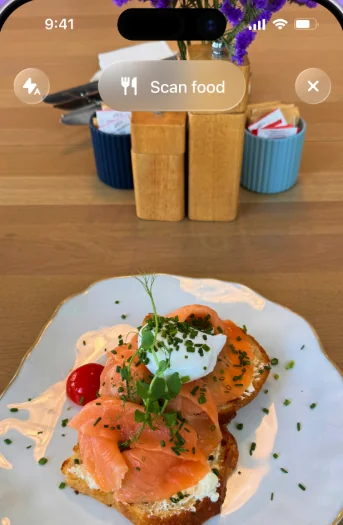
Nutrition from a photo. I led features that use computer vision to analyse a meal from a photo, reaching 99% accuracy.
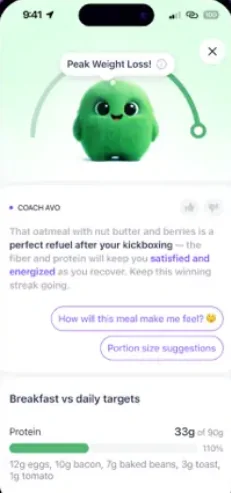
Logging in plain language. People describe what they ate in their own words, in conversation with the coach and it becomes a structured log entry. Across the 5,000 most frequent weekly logs, both recall and precision are above 95%.
The Simple Method. With the coaching and behaviour change teams, I introduced the Simple Method, a proprietary, patent-pending approach in which the coach sets daily tasks that fit each person’s context and progress as their weight loss does.
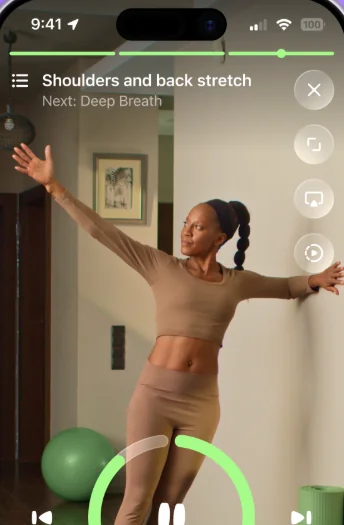
Exercise and content. I built an AI-led exercise and content strategy from the ground up, supporting marketing and growth as they opened new customer segments and funnels across tai chi, walking, calisthenics and general fitness.
Experimentation. I drove a programme of experiments across retention, engagement, churn reduction and upsell conversion - working closely with CRM teams, marketing and data science.
Science-backed weight loss and behaviour change
An analysis of 23,445 Simple users, presented at ObesityWeek 2024, found weight loss rising with how consistently people talked to the AI coach over three months. Each additional ten days of conversation was associated with around 0.17% more weight loss, and using the rest of the app alongside the coach added about 0.56%. A separate peer-reviewed study of 53,482 users in Obesity Science & Practice found a similar pattern across the app as a whole: a median 5.04% weight loss at 26 weeks among engaged users, with more than half reaching clinically meaningful loss.
Weight loss rose from roughly 2.9% among users who talked to the coach on one to four days to around 6.1% among those who did so on 30 days or more, and higher engagement was associated with better nutritional quality in logged meals. These are associations rather than causal effects; users who stay are different from users who leave. The reason to say so plainly is that it changes what you build. If continued use is partly a selection effect, the product work worth doing is whatever moves people into the engaged group early, rather than whatever correlates with being in it.
How the team works
I run the team on an AI-first model, building prototyping directly alongside UX, AI run user testing and feedback, directly working alongside coding agents writing production front-end and back-end code into CI under engineering review. I also trained the clinical team in hazard analysis and safety assessment for AI features, a practice carried over from clinical deployment into consumer health.
References
- Huntriss R, Salimgaraev R, Nikogosov D, Powell J, Varady KA. The effectiveness of mobile app usage in facilitating weight loss: an observational study. Obesity Science & Practice, 2024; 10(3).
- AI coach engagement and weight loss, poster presented at ObesityWeek 2024, San Antonio. Abstract published in Obesity.
- Best Virtual Health Coach, MedTech Breakthrough Awards, 2025 & 2026